

Introduction to Di-Cationic and Tri-Cationic Zinc Phosphate Coatings
Introduction
Proper surface preparation of metals before painting has a direct impact on the quality and durability of the paint coating. Even the best paint will not form a suitable coating on a surface that has not been properly prepared.
Di-Cationic and Tri-Cationic Zinc Phosphate Coatings
One of the most common methods of surface preparation is the formation of a zinc phosphate coating (Zinc Phosphate Coating), which is a type of chemical conversion coating. In this process, an insoluble layer of zinc phosphate compounds is formed on the metal surface. This layer chemically bonds to the metal surface and provides a corrosion-resistant base for the paint.
Zinc Phosphate Coatings
Due to their significant improvement in paint adhesion and corrosion resistance, zinc phosphate coatings are widely used in the automotive, appliance, and metalworking industries and have largely replaced more toxic lead- and chromium-based coatings.
Based on their chemical composition, zinc phosphate coatings are classified into several types, including mono-cationic (containing only zinc ions), di-cationic, and tri-cationic coatings.
In di-cationic and tri-cationic coatings, in addition to zinc ions, other metal ions are present to improve coating performance, which will be examined in detail below.
In this article, the formation process of zinc phosphate coatings, their crystalline structure, and the role of these coatings in improving paint adhesion and corrosion resistance are described. Di-cationic coatings are also compared with tri-cationic coatings in terms of composition, performance, and industrial applications. In addition, the benefits of using zinc phosphate coatings, methods for optimizing the process, comparisons with other surface preparation methods, and related industrial tests are discussed.
Also Read…
Key Solutions for Optimizing the Zinc Phosphating Process
Chemical Process of Zinc Phosphate Coating Formation
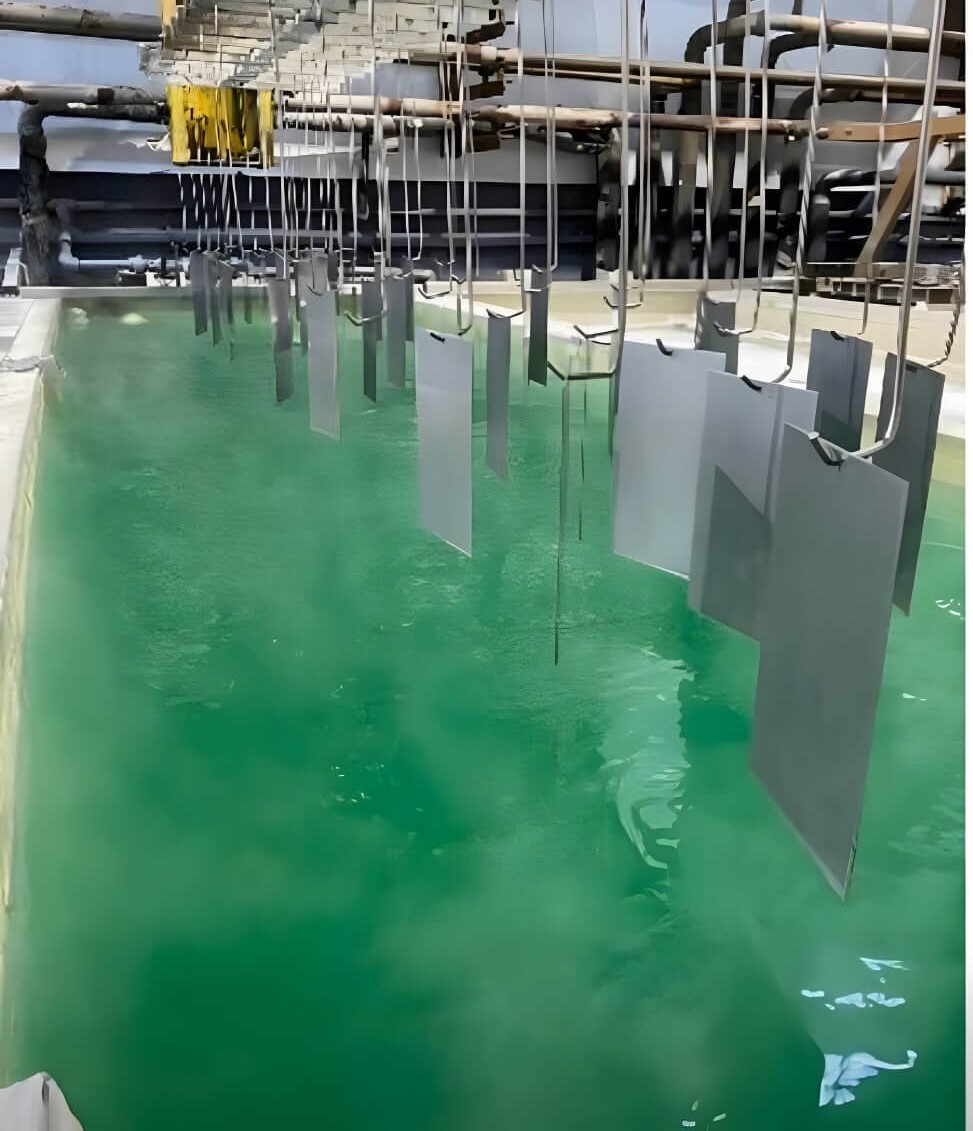
Phosphating is a chemical conversion process in which the surface of the base metal is exposed to a solution of phosphoric acid and zinc phosphate salts, resulting in the formation of a metal phosphate layer on the surface.
The reaction mechanism is such that the acidic component of the bath (phosphoric acid) slightly dissolves the metal surface, releasing metal ions (such as Fe^2+ from iron). At the same time, phosphate and zinc ions present in the solution combine with these metal ions, and insoluble zinc phosphate crystals precipitate on the surface.
The result of this reaction is the formation of a crystalline layer consisting of metal phosphates such as hopeite (Zn₃(PO₄)₂·4H₂O) and other zinc/iron phosphates, which chemically bond to the metal substrate.
The phosphating reaction is accompanied by the generation of hydrogen gas and continues until the entire metal surface is covered with phosphate crystals. Once the layer has formed, the reaction stops because the phosphate layer acts as a barrier between the metal and the solution, preventing further acid attack on the metal.
For this reason, prolonged immersion of parts in the phosphating bath is not recommended, because after the surface becomes saturated, the formed layer dissolves again in the acid and a new layer is formed. This cycle only results in unnecessary consumption of chemicals and increased sludge (bath sediment).
The crystalline structure of a zinc phosphate coating is generally fine-grained and porous. The size of the phosphate crystals can range from approximately 0.3 to 1 micron, depending on process conditions such as temperature, concentration, additives, and pre-activation.
Fine and uniform crystals are preferred for better properties because they create a denser and more continuous coating, leaving fewer areas of the surface uncoated. To achieve such a structure, a surface activation stage is generally used before phosphating.
During this stage, the part is immersed in solutions containing very fine crystalline powders (typically titanium compounds) to create nucleation sites for the formation of phosphate crystals. Activation causes the resulting phosphate coating to have very fine grains and a uniform distribution.
In addition to activation, accelerating additives (Accelerators) are also added to the phosphating bath to improve the coating structure. Accelerators, which are typically oxidizing compounds such as sodium nitrite or chlorates, increase the coating formation rate by oxidizing ferrous ions (Fe^2+) to ferric ions (Fe^3+) and reducing hydrogen gas evolution at the surface, resulting in finer and more compact crystals.
The result of these measures is the formation of a phosphate layer with an optimized crystalline structure, providing higher adhesion and corrosion resistance.
Effect of Zinc Phosphate Coating on Paint Adhesion and Corrosion Resistance: Zinc phosphate coating creates an ideal intermediate layer for paint, offering benefits in several ways.
First, due to its crystalline and porous nature, the coating roughens and activates the metal surface, allowing the paint to penetrate the microscopic pores and become mechanically anchored within them.
Furthermore, because the phosphate compounds are chemically bonded to the base metal, the paint or subsequent coating can also form a strong chemical bond with the metal surface indirectly. As a result, paint adhesion (Adhesion) is significantly improved.
On the other hand, the zinc phosphate coating itself acts as a protective layer against corrosion.
This phosphate layer is relatively inert and non-conductive and prevents direct contact between the metal and corrosive agents. In addition, because the phosphate coating absorbs moisture and oil, it can retain oil-based primers, waxes, or hydrophobic coatings within its structure, thereby increasing the corrosion resistance of the substrate.
Taken together, these factors ensure that parts that are phosphated and subsequently painted have significantly greater durability in corrosive environments than painted parts without phosphating.
Tri-cation zinc phosphate conversion coating and process of making the same
In summary,
Phosphating the surface creates a clean, rough, active, and corrosion-resistant surface that maximizes the adhesion of subsequent coatings and prevents underfilm rusting beneath the paint layer.
In the next article, we discuss Comparison of Di-Cationic and Tri-Cationic Zinc Phosphating.
For more information about FYP Zinc Phosphate Products, you can visit the link.


No comment for this post.