

Nanotechnology in Manganese Phosphate Coatings: A Revolution in Industrial Surface Protection

Introduction
Manganese phosphate coatings are among the most widely used conversion coatings in industry and, due to their unique properties, play an important role in protecting metal parts, particularly steel components. With advances in nanotechnology, a new generation of manganese phosphate coatings incorporating nanostructured additives has been developed, significantly improving their protective performance and mechanical properties. In this article, we examine the latest advances in nanotechnology in the field of manganese phosphate coatings and their impact on various industries.
Nanostructured Additives in Manganese Phosphate Coatings
Silica Nanoparticles (SiO₂)
One of the most important nanostructured additives that has found widespread application in the phosphate coating industry is silica nanoparticles. With dimensions of approximately 20–100 nanometers, silica nanoparticles act as new accelerators and significantly improve the corrosion resistance of phosphate coatings. By filling the pores present in the manganese phosphate crystal structure, these nanoparticles increase coating uniformity and reduce its permeability to corrosive agents.
Zinc Oxide (ZnO) Nanocomposites
Nanoscale zinc oxide nanocomposites, when incorporated into manganese phosphate coatings, create hybrid coatings that simultaneously improve corrosion and wear resistance. Combining these nanoparticles with the manganese phosphate structure results in finer and denser crystals that provide greater resistance to environmental factors.
Titanium Dioxide (TiO₂) Nanoparticles
The addition of titanium dioxide nanoparticles to manganese phosphate baths creates a new generation of photocatalytic coatings that, in addition to corrosion protection, exhibit self-cleaning properties. By absorbing UV light, these nanoparticles catalyze oxidation reactions and promote the decomposition of organic contaminants on the surface.
Cerium Oxide (CeO₂) Nanoparticles
Cerium oxide nanoparticles act as corrosion inhibitors and significantly increase the corrosion resistance of manganese phosphate coatings. By creating an additional protective layer, these nanoparticles protect the metal surface against electrochemical attack.
Mechanisms of Nanostructured Additives in Manganese Phosphate Coatings
Nanostructured additives improve the performance of manganese phosphate coatings through several mechanisms:
- Microstructure Control: Nanoparticles act as nucleation sites, resulting in the formation of finer and more uniform crystals. This leads to denser coatings with lower porosity.
- Pore Filling: Nanoparticles of suitable size can fill the voids and pores present in the phosphate coating structure, reducing the penetration of corrosive agents toward the metal surface.
- Hydrophobic Properties: Some nanostructured additives can increase the hydrophobicity of the surface, reducing water absorption and consequently decreasing corrosion.
- Improved Adhesion: Nanoparticles improve coating adhesion by increasing the contact area between the coating and substrate.
- Antimicrobial Properties: Some nanostructured additives, such as silver nanoparticles or zinc oxide nanoparticles, have antimicrobial properties that are highly beneficial for specific applications such as medical equipment and food industries.
Advanced Technologies for Applying Nanostructured Manganese Phosphate Coatings
Electrically Assisted Immersion Method
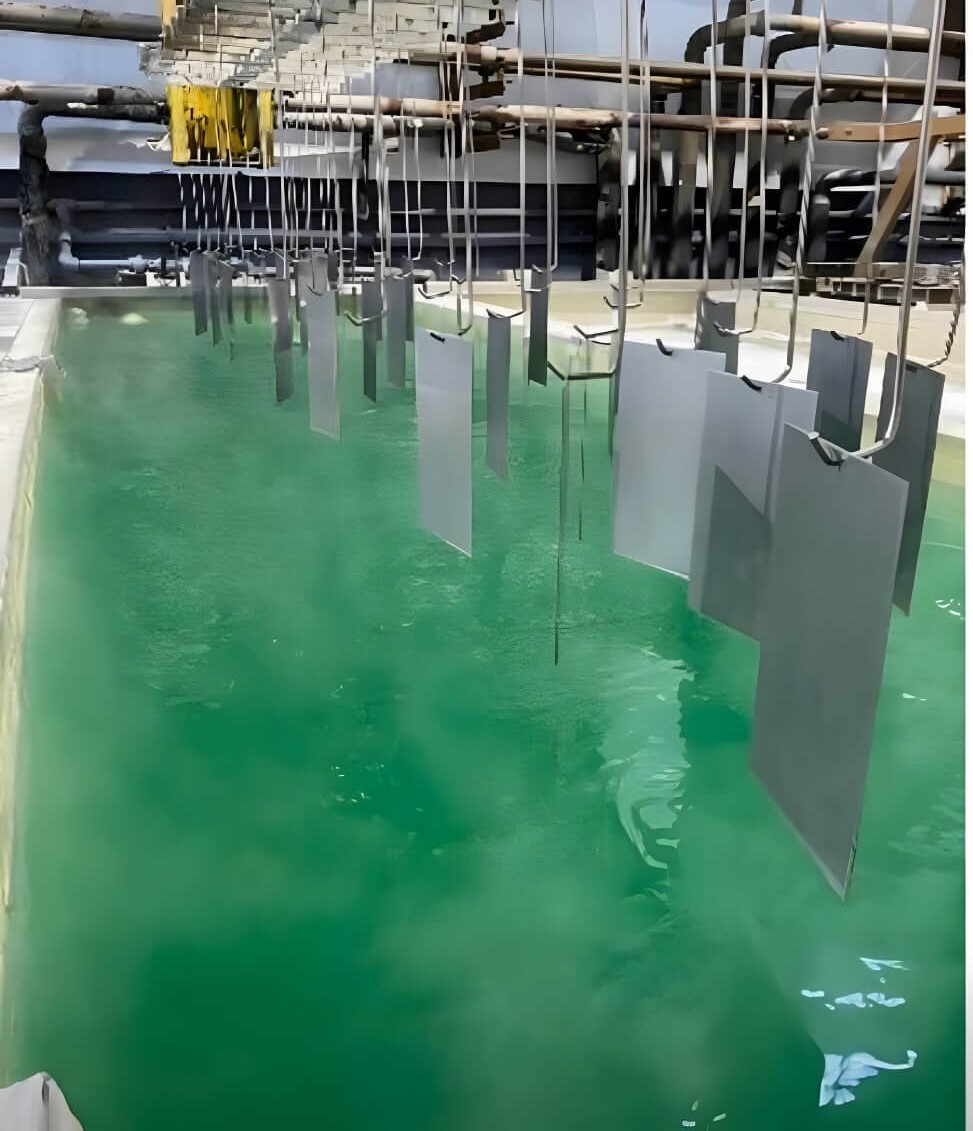
In this method, applying a weak electric field during the phosphating process enables nanoparticles to be distributed more uniformly throughout the coating structure. This technology increases process speed and reduces the operating temperature to approximately 70°C, making it highly desirable from both economic and environmental perspectives.
Rotational Phosphating Method
The use of horizontally moving and rotating systems during the phosphating process prevents hydrogen accumulation in cavities and produces a more uniform coating. This technology is particularly suitable for parts with complex geometries.
Pulsed Phosphating Method
Instead of continuously applying the coating, this method uses short-duration pulses, resulting in nanostructured coatings with higher density and improved corrosion resistance. This technology also reduces chemical consumption.
Advantages of Nanostructured Manganese Phosphate Coatings
- Exceptional Corrosion Resistance
Nanostructured manganese phosphate coatings can increase corrosion resistance by up to three times compared with conventional coatings. This is attributed to the denser and less permeable structure of the coating in the presence of nanoparticles.
- Higher Hardness and Wear Resistance
Hardening nanoparticles such as titanium oxide or aluminum oxide increase the hardness and wear resistance of manganese phosphate coatings, extending the service life of components under demanding operating conditions.
- Improved Lubricating Properties
The nanoscale structure of manganese phosphate coatings enables better absorption and retention of oils and lubricants, thereby improving lubricating properties. This characteristic is particularly important for moving components such as gears and bearings.
- Environmental Compatibility
Nanotechnology enables the development of manganese phosphate coatings using fewer chemicals and lower temperatures, resulting in reduced energy consumption and environmental pollution.
- Reduced Process Time
The presence of accelerating nanoparticles such as nanosilica reduces phosphating process time, increasing productivity and lowering production costs.
Industrial Applications of Nanostructured Manganese Phosphate Coatings
Automotive Industry
In the automotive industry, nanostructured manganese phosphate coatings are used for gearbox components, engine parts, brake and clutch systems, and springs. These coatings increase component service life, reduce friction, and improve performance.
Oil and Gas Industries
In the oil and gas industries, nanostructured manganese phosphate coatings are used to protect subsea equipment, pipes, fittings, valves, and other components exposed to corrosive environments.
Military and Aerospace Industries
In military and aerospace industries, nanostructured manganese phosphate coatings are used on weapon components, ammunition, and aircraft equipment that must withstand harsh environmental conditions.
Industrial Machinery
In industrial machinery, nanostructured manganese phosphate coatings are used on cutting tools, drills, molds, and other components subjected to mechanical stress.
Challenges and Future of Nanostructured Manganese Phosphate Coatings
Despite the many advantages of nanostructured manganese phosphate coatings, several challenges remain:
- Control of Nanoparticle Distribution: One of the main challenges is ensuring the uniform distribution of nanoparticles throughout the coating structure. Nanoparticle agglomeration can weaken coating properties.
- Production Costs: Some nanostructured additives are still expensive, although their cost is decreasing as production technologies advance.
- Safety Considerations: Safety and health considerations must be taken into account when using nanoparticles.
In the future, the following developments are expected in the field of nanostructured manganese phosphate coatings:
- Development of Multifunctional Nanostructured Additives: Nanoparticles that simultaneously improve several properties, such as corrosion resistance, wear resistance, and antimicrobial performance.
- Self-Healing Systems: Smart coatings capable of automatically repairing damage.
- Green Processes: Methods for producing manganese phosphate coatings without the use of environmentally harmful chemicals.
Sodium silicate assisted manganese phosphate chemical conversion coating on D2 steel at various concentration
Conclusion
Nanotechnology has created a revolution in the field of manganese phosphate coatings. Nanostructured manganese phosphate coatings, through the use of advanced nanoparticles, offer significantly improved performance and properties compared with conventional coatings. By increasing corrosion resistance, hardness, and lubricating properties, these coatings extend the service life of industrial components and reduce maintenance and replacement costs.
With continued advances in nanotechnology, it is expected that a new generation of smart manganese phosphate coatings will be developed in the near future, capable of automatically adapting to environmental conditions and providing optimized performance.
To learn more about the FYP Phosphating Products, you can visit the relevant section of the website or complete and submit the appropriate forms on the main website to receive consultation, after which our specialists will contact you.



No comment for this post.